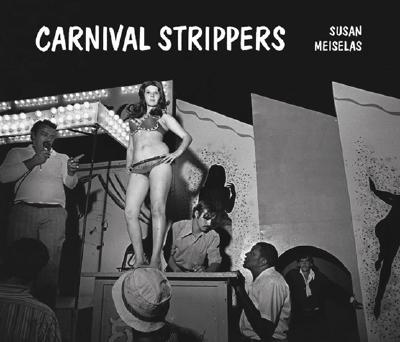
From 1972 to 1975, Susan Meiselas spent her summers photographing and interviewing women who performed striptease for smalltown carnivals in New England, Pennsylvania and South Carolina. As she followed the girl shows from town to town, she portrayed the dancers on stage and off, photographing their public performances as well as their private lives.
Read More
From 1972 to 1975, Susan Meiselas spent her summers photographing and interviewing women who performed striptease for smalltown carnivals in New England, Pennsylvania and South Carolina. As she followed the girl shows from town to town, she portrayed the dancers on stage and off, photographing their public performances as well as their private lives.
Read Less
Add this copy of Carnival Strippers to cart. $195.00, like new condition, Sold by Design Books rated 5.0 out of 5 stars, ships from New York, NY, UNITED STATES, published 2003 by Whitney Museum of Art and Steidl,.
Choose your shipping method in Checkout. Costs may vary based on destination.
Seller's Description:
Fine in Fine jacket. This is a fine hardcover copy with a fine dust jacket with no wear at all. Completely clean. This is the revised edition of 2003. CD in rear of book. Essays by Sylvia Wolf and Deirdre English. Illustrated in black & white with Susan Meisalas' photographs. 10" high X 11" wide, 164 pages. Large heavy book foreign shipping will be extra. This book will be securely wrapped and packed in a sturdy box and shipped with tracking.
Add this copy of Carnival Strippers to cart. $224.95, very good condition, Sold by Salish Sea Books rated 5.0 out of 5 stars, ships from Bellingham, WA, UNITED STATES, published 2003 by Steidl Publishing.
Choose your shipping method in Checkout. Costs may vary based on destination.
Seller's Description:
** CD is included **; Very Good in a Good++ dust jacket; Hardcover; Dust jacket is lightly shelfworn and edgeworn with a few small handling-marks, otherwise is clean and intact with no tears, and has not been price-clipped (Now fitted with a new, Brodart jacket protector); Light wear to the boards; Unblemished textblock edges; Gift inscription to the half-title page, otherwise the endpapers and all text pages are clean and unmarked; The binding is excellent with a straight spine; This book will be shipped in a sturdy cardboard box with foam padding; Medium-Large, Oblong Format (Quatro, 9.75"-10.75" tall); 2.5 lbs; Black dust jacket with photo illustration, and title in white lettering; 2003, Steidl Publishing; 164 pages; "Carnival Strippers, " by Susan Meiselas.
Add this copy of Carnival Strippers to cart. $330.00, like new condition, Sold by Lorne Bair Rare Books, Inc rated 4.0 out of 5 stars, ships from Winchester, VA, UNITED STATES, published 2003 by Whitney Museum of American Art.
Choose your shipping method in Checkout. Costs may vary based on destination.
Seller's Description:
4to. 28cm x 24cm. Publisher's black cloth boards. Dustjacket. Titled in silver gilt to spine and front board. A fine copy in dustjacket. 163pp. Internally clean. Packed to the tent pegs with black and white images and interviews depicting the now disappeared world of the carnival sex workers of the mid 1970's, even then a period of change and decay rather than a heyday. Meiselas's original publication in 1976 has always been a cult object, long out of print and prime for a new edition. This copy is signed by Meiselas to the title page, and has an additional CD of interviews and additional material to the rear. By turns sleazy, funny, sad, and fascinating, it's never less than a skilfully rendered view of a lost piece of Americana.
Add this copy of Carnival Strippers (Signed First Edition) to cart. $350.00, like new condition, Sold by Jeff Hirsch Books rated 4.0 out of 5 stars, ships from Wadsworth, IL, UNITED STATES, published 2003 by Steidl / Whitney Museum.
Choose your shipping method in Checkout. Costs may vary based on destination.
Seller's Description:
First edition thus. Hardcover. 163 pages. A reissue edition of her classic first book. Features text by Sylvia Wolf and Deirdre English. Includes 78 black and white images and an audio cd that features an interview with Meiselas in 1977. A fine copy in fine dust jacket. Signed by Meiselas on the title page and dated in 2004. A lovely copy.
Add this copy of Carnival Strippers (Signed First Edition) to cart. $350.00, very good condition, Sold by Jeff Hirsch Books rated 4.0 out of 5 stars, ships from Wadsworth, IL, UNITED STATES, published 1976 by Farrar Straus and Giroux.
Choose your shipping method in Checkout. Costs may vary based on destination.
Seller's Description:
First edition and first printing. Oblong softcover. Simultaneous paperback issue of Meiselas' important first book. A collection of black and white photographs all set at stripshows. Also includes text by Meiselas about the various women. A clean near fine copy in photo-illustrated wrappers with some very minor wear. Internally a clean copy. Signed by Meiselas on the title page in 2004. (Roth 238-239).
"Carnival Strippers" is a photographic documentary of the carnival strip shows that flourished in county fairs in small-town New England through the late 1970s. The book consists of photographs of the strippers, the managers, callers, and barkers who run the shows, and their customers, or "marks".
The book first appeared in 1976. The photographer, Susan Meiselas, was at the time a young woman just out of graduate school. She spent the summers of 1972 -- 1975 following the carnivals and in getting to know the women to photograph them and their environs. She at first offered her photographs and interviews to various feminist publications who turned them down.
Meiselas subsequently went on to a distinguished career as a documentary photographer working extensively in Central America and Kurdistan. In 1992, Meiselas was named a MacArthur Fellow.
"Carnival Strippers" received attention upon its initial publication for its frank, but nonjudgmental portrayal of its tawdry subject. The book was made into two plays before it, like the carnival strip shows themselves disappeared from attention. Then, in 2000, the Whitney Museum of American Art in New York City featured a retrospective of the photographs. The Whitney Museum published this second edition of "Carnival Strippers" in 2003 with Sylvia Wolf, curator of photography at the Museum contributing an essay. Deidre English of the Graduate School of Photojournalism at the University of California at Berkeley has also written an essay for the book.
In the 2003 edition, 16 new photographs are added from Meiselas's source materials and 13 photographs that appeared in the 1976 edition are deleted, making a total of 76 photographs in the book. The new edition is also rearranged from the initial text. There are two sections of photographs, the first called "the girl show" and the second called "portraits". The essays by Wolf and English draw parallels between Meiselas's work and the work of Brassi's 1930 photos of Paris prostitutes, as well as with the work of contemporary photographers such as Diane Arbus. To me the strongest parallel is Belloq's collection of photographs of prostitutes in Storyville, New Orleans dating from the turn of the century.
In the grainy black-and-white photographs of the life of the carnival strip shows, we meet the women and the barkers on the front stage called a "bally" enticing the men to enter the show. For a price of $2 or $3, the show consisted of four or five women each dancing naked to, generally, a single 45 rpm record. The book shows photos of the girls at work to crowds of leering men. The world of the "girl shows" was competitive and nasty. We see the girls off-stage in dressing rooms and in private moments reflecting on their lives. There are extensive interviews with the strippers, the managers and barkers and the patrons. The book also comes with a CD featuring the sounds of the strip shows, interviews with the girls, and a 1997 interview with Susan Meiselas.
The book paints the picture of a low, tawdry life with mutual exploitation between the girls, their managers, and the patrons. Yet it is a way of life not without its fascination. It is a life of poor, mostly ignorant, and exploited women, but also a life based upon the rejection of convention and upon attempts to attain independence. Meiselas clearly became taken with the strippers, their attempt at independence, their eccentricities, their vulnerability, and their vulgarity. For Meiselas and her subjects, Carnival life is something that gets in the person, making it hard to leave when one has been exposed. I found the life of these now gone carnivals and girl shows got inside me as well in reading this book.
The women in this book are not beautiful, air-brushed models and the book has little to offer in the way of titillation. Meiselas tries to show the viewer and the reader the carnival life for what it was. The book shows a dark corner of the eternal theme of sexuality and love between men and women in all its difficulty and ambiguity.
Why no voting buttons? We don't let customers vote on their own reviews, so the voting buttons appear only when you look at reviews submitted by others. Permalink
Comment Comment
8 of 8 people found the following review helpful:
5.0 out of 5 stars They strip to please, not to tease..., September 15, 2006
By Ben Trevett "Beny The Balloon Guy" (Seattle) - See all my reviews
This review is from: Susan Meiselas: Carnival Strippers (Hardcover)
Frankly this book is incredible. I'm a carnival performer and history buff and in my opinion it's always been a tragedy that carnivals of yesteryear are remembered now almost entirely for the sideshows. Rides, games, spook houses and sex were all part of the classic carnival allure; this book is dedicated to the latter and portrays the Girlshow at it's best and most real.
Most impressive to me was the fact the author says almost nothing of her own opinions or ideas regarding the girls, the talkers or the lifestyle. Instead the reader is simply treated to the text of her interviews and therefore only the ideas of the people who performed and in some cases the people that watched.
As performer I was especially pleased to read in it's entirety an original Girlshow "talk" or "bally" at the front of the book, and I love the unabashed and often casual photos taken back stage, all of witch give one an insiders sense of what it must have been like in the glory days. Help other customers find the most helpful reviews
Was this review helpful to you? Report this | Permalink
Comment Comment
6 of 6 people found the following review helpful:
5.0 out of 5 stars Documentary photography at its best, April 6, 2005
By Tamii - See all my reviews
This review is from: Susan Meiselas: Carnival Strippers (Hardcover)
As a small kid, I was always fascinated by the carnival strippers and the forbidden world behind the platform. Finally, these pictures outline what that world was like for those women who danced. No, the pictures aren't pretty, but realistic and honest. I came away from these pics with more respect for the kind of work that these ladies did. The world of the carnival stripper is gone, but these wonderful and gritty pictures allow us one more intimate look at an all but forgotten time period.