A landmark work by a philosopher whom the New York Times said writes the best kind of philosophy--critical, economical, and clear." Why do major historical events such as the Holocaust occupy the forefront of the collective consciousness, while profound moments such as the Armenian genocide, the McCarthy era, and France's role in North Africa stand distantly behind? Is it possible that history "overly remembers" some events at the expense of others? A landmark work in philosophy, Paul Ricoeur's Memory, History, ...
Read More
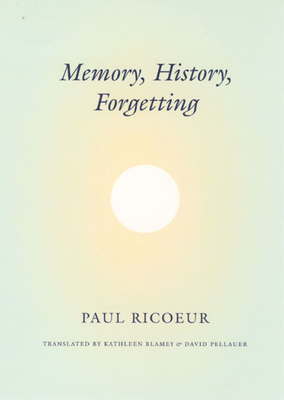
A landmark work by a philosopher whom the New York Times said writes the best kind of philosophy--critical, economical, and clear." Why do major historical events such as the Holocaust occupy the forefront of the collective consciousness, while profound moments such as the Armenian genocide, the McCarthy era, and France's role in North Africa stand distantly behind? Is it possible that history "overly remembers" some events at the expense of others? A landmark work in philosophy, Paul Ricoeur's Memory, History, Forgetting examines this reciprocal relationship between remembering and forgetting, showing how it affects both the perception of historical experience and the production of historical narrative. Memory, History, Forgetting , like its title, is divided into three major sections. Ricoeur first takes a phenomenological approach to memory and mnemonical devices. The underlying question here is how a memory of present can be of something absent, the past. The second section addresses recent work by historians by reopening the question of the nature and truth of historical knowledge. Ricoeur explores whether historians, who can write a history of memory, can truly break with all dependence on memory, including memories that resist representation. The third and final section is a profound meditation on the necessity of forgetting as a condition for the possibility of remembering, and whether there can be something like happy forgetting in parallel to happy memory. Throughout the book there are careful and close readings of the texts of Aristotle and Plato, of Descartes and Kant, and of Halbwachs and Pierre Nora. A momentous achievement in the career of one of the most significant philosophers of our age, Memory, History, Forgetting provides the crucial link between Ricoeur's Time and Narrative and Oneself as Another and his recent reflections on ethics and the problems of responsibility and representation.
Read Less
Add this copy of Memory, History, Forgetting to cart. $29.02, new condition, Sold by SurplusTextSeller rated 5.0 out of 5 stars, ships from Columbia, MO, UNITED STATES, published 2006 by University of Chicago Press.
Add this copy of Memory, History, Forgetting Format: Paperback to cart. $29.97, new condition, Sold by indoo rated 5.0 out of 5 stars, ships from Avenel, NJ, UNITED STATES, published 2006 by University of Chicago Press.
Add this copy of Memory, History, Forgetting to cart. $34.22, new condition, Sold by Ingram Customer Returns Center rated 5.0 out of 5 stars, ships from NV, USA, published 2006 by University of Chicago Press.
Add this copy of Memory, History, Forgetting to cart. $72.53, new condition, Sold by Bonita rated 4.0 out of 5 stars, ships from Santa Clarita, CA, UNITED STATES, published 2006 by University of Chicago Press.
Add this copy of Memory, History, Forgetting to cart. $121.67, new condition, Sold by Just one more Chapter rated 4.0 out of 5 stars, ships from Miramar, FL, UNITED STATES, published 2004 by University of Chicago Press.
Add this copy of Memory, History, Forgetting to cart. $149.54, new condition, Sold by GridFreed rated 5.0 out of 5 stars, ships from San Diego, CA, UNITED STATES, published 2004 by University of Chicago Press.