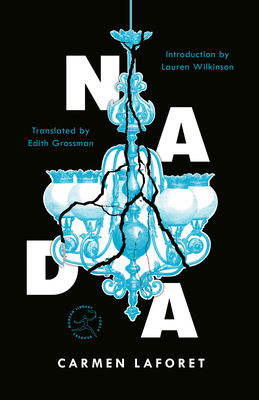
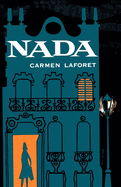
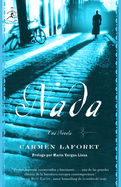
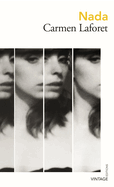
Carmen Laforet's Nada ranks among the most important literary works of post-Civil War Spain. Loosely based on the author's own life, it is the story of an orphaned young woman who leaves her small town to attend university in war-ravaged Barcelona. Residing amid genteel poverty in a mysterious house on Calle de Aribau, young Andrea falls in with a wealthy band of schoolmates who provide a rich counterpoint to the squalor of her home life. As experience overtakes innocence, Andrea gradually learns the disquieting truth about ... Read More
Carmen Laforet's Nada ranks among the most important literary works of post-Civil War Spain. Loosely based on the author's own life, it is the story of an orphaned young woman who leaves her small town to attend university in war-ravaged Barcelona. Residing amid genteel poverty in a mysterious house on Calle de Aribau, young Andrea falls in with a wealthy band of schoolmates who provide a rich counterpoint to the squalor of her home life. As experience overtakes innocence, Andrea gradually learns the disquieting truth about the people she shares her life with: her overbearing and superstitious aunt Angustias; her nihilistic yet artistically gifted uncle Roma n and his violent brother Juan; and Juan's disturbingly beautiful wife, Gloria, who secretly supports the clan with her gambling. From existential crisis to a growing maturity and resolve, Andrea's passionate inner journey leaves her wiser, stronger, and filled with hope for the future. The incomparable Edith Grossman's vital new translation captures the feverish energy of Laforet's magnificent story, showcasing its dark, powerful imagery, and its subtle humor. And Mario Vargas Llosa's Introduction illuminates Laforet's brilliant depiction of life during the early days of the Franco regime. With crystalline insight into the human condition, Carmen Laforet's classic novel stands poised to reclaim its place as one of the great novels of twentieth-century Europe. Read Less
Add this copy of Nada: a Novel (Modern Library Classics) to cart. $3.57, good condition, Sold by More Than Words rated 5.0 out of 5 stars, ships from Waltham, MA, UNITED STATES, published 2008 by Random House Publishing Group.
Choose your shipping method in Checkout. Costs may vary based on destination.
Seller's Description:
Good. . All orders guaranteed and ship within 24 hours. Your purchase supports More Than Words, a nonprofit job training program for youth, empowering youth to take charge of their lives by taking charge of a business.
Add this copy of Nada: a Novel (Modern Library Torchbearers) to cart. $3.57, fair condition, Sold by Blue Vase Books rated 5.0 out of 5 stars, ships from Interlochen, MI, UNITED STATES, published 2008 by Random House Publishing Group.
Choose your shipping method in Checkout. Costs may vary based on destination.
Seller's Description:
Fair. The item is very worn but is perfectly usable. Signs of wear can include aesthetic issues such as scratches dents worn and creased covers folded page corners and minor liquid stains. All pages and the cover are intact but the dust cover may be missing. Pages may include moderate to heavy amount of notes and highlighting but the text is not obscured or unreadable. Page edges may have foxing age related spots and browning. May NOT include discs access code or other supplemental materials.
Add this copy of Nada: a Novel (Modern Library Classics) to cart. $4.54, very good condition, Sold by HPB-Diamond rated 4.0 out of 5 stars, ships from Dallas, TX, UNITED STATES, published 2008 by Modern Library.
Choose your shipping method in Checkout. Costs may vary based on destination.
Seller's Description:
Very good. Connecting readers with great books since 1972! Used books may not include companion materials, and may have some shelf wear or limited writing. We ship orders daily and Customer Service is our top priority!
Add this copy of Nada: a Novel (Modern Library Torchbearers) to cart. $5.03, fair condition, Sold by BooksRun rated 4.0 out of 5 stars, ships from Philadelphia, PA, UNITED STATES, published 2008 by Modern Library.
Choose your shipping method in Checkout. Costs may vary based on destination.
Seller's Description:
Fair. The item might be beaten up but readable. May contain markings or highlighting, as well as stains, bent corners, or any other major defect, but the text is not obscured in any way.
Add this copy of Nada: a Novel (Modern Library Classics) to cart. $5.59, very good condition, Sold by HPB-Emerald rated 4.0 out of 5 stars, ships from Dallas, TX, UNITED STATES, published 2008 by Modern Library.
Choose your shipping method in Checkout. Costs may vary based on destination.
Seller's Description:
Very good. Connecting readers with great books since 1972! Used books may not include companion materials, and may have some shelf wear or limited writing. We ship orders daily and Customer Service is our top priority!
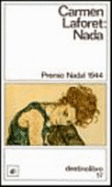
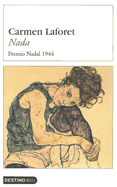
Add this copy of Nada (Destinolibro) (Spanish Edition) to cart. $5.69, very good condition, Sold by ThriftBooks-Baltimore rated 4.0 out of 5 stars, ships from Halethorpe, MD, UNITED STATES, published 1996 by Destino.
Add this copy of Nada (Destinolibro) (Spanish Edition) to cart. $5.69, very good condition, Sold by ThriftBooks-Reno rated 4.0 out of 5 stars, ships from Reno, NV, UNITED STATES, published 1996 by Destino.
Add this copy of Nada (Destinolibro) (Spanish Edition) to cart. $5.69, good condition, Sold by ThriftBooks-Reno rated 4.0 out of 5 stars, ships from Reno, NV, UNITED STATES, published 1996 by Destino.
Add this copy of Nada (Destinolibro) (Spanish Edition) to cart. $5.69, good condition, Sold by ThriftBooks-Dallas rated 4.0 out of 5 stars, ships from Dallas, TX, UNITED STATES, published 1996 by Destino.
Add this copy of Nada (Destinolibro) (Spanish Edition) to cart. $5.71, very good condition, Sold by ThriftBooks-Atlanta rated 4.0 out of 5 stars, ships from Austell, GA, UNITED STATES, published 1996 by Destino.
Viva! Viva, Carmen Laforet, my hero, and Nada, a miracle novel from an author so young.
The setting is around 1941-42, after the Spanish Civil War, when Spain is not involved in World War II but feeling the claustrophobic and repressive aftermath of their national implosion. Other readers will have told you the plot of this novel, but what you need to know about Nada is that Andrea arrives in Barcelona at midnight, and the following year leaves in broad daylight. What a relief at the end when Ena's kind father offers Andrea a sort of "get away" car to rejoin his family in Madrid, with a good breakfast and lunch along the way--what Andrea's own family could not provide.
The setting might be Barcelona, Spain, but there is something alarmingly universal about a girl's attempt to overcome the limitations of her family and discover who she is through university-level study. How does a young woman create herself under adverse circumstances? (It's a kind of third-world story that also happens in the so-called first-world.) Early in the novel, Andrea's Aunt Angustias notes that Andrea went to a sort of high school run by nuns, but that it was in a village (one assumes where scholarly achievement was not expected); and we learn that the Barcelona home of her grandmother (with miserable aunt and uncles) is her only chance of creating herself, of attending a university, and escaping through studying literature. In the course of the year, Andrea must navigate some extremely uncomfortable emotions; she loses her best friend, Ena (but finds her again, later). Boyfriends elude her. The irony of all such novels is that it's the horrible family who gives the author the story (in which case there are no villains, only victims). This notion is fully realized in her often vile Uncle Roman, who plays the violin so poignantly that you can hear it in Laforet's words, Grossman's elegant translation.
As a final note, when I was 18, I didn't know that Carmen Laforet and her main character, Andrea, existed. I was reading Hesse's Demian at the time--another book about a young life developing through school. But now that this novel, Nada, has been brilliantly translated into an affordable Modern Library edition, university faculty should make it assigned reading (high school students will love this, too). Maybe the pleasure of reading is for those of us who are older; more than ever, I can understand that Andrea gets an exquisite experience of Barcelona when she strolls (or runs) through the streets after dark: the cool air, the quiet, the stars in the night sky, "an anguished harmony without light," an aesthetic experience all her own. Andrea, on a winter stroll, recounts, "Then I knew what I longed for: I wanted to see the Cathedral enveloped in the charm and mystery of the night. . . . Nothing could calm and astound my imagination like that Gothic city. . ." (92). Ah!