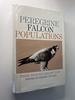
Add this copy of Peregrine Falcon Populations; : Their Biology and to cart. $34.00, good condition, Sold by ThriftBooks-Dallas rated 4.0 out of 5 stars, ships from Dallas, TX, UNITED STATES, published 1969 by University of Wisconsin Press.
Choose your shipping method in Checkout. Costs may vary based on destination.
Seller's Description:
Good. Shelf and handling wear to cover and binding, with general signs of previous use. Boards may have fading and nicks and other signs of wear and imperfection commensurate with age. Binding is tight and structurally sound. Pages unmarked. Sealed in plastic for shipping. Secure packaging for safe delivery.
Add this copy of Peregrine Falcon Populations: Their Biology and Decline to cart. $55.00, very good condition, Sold by Crossroad Books rated 5.0 out of 5 stars, ships from Eau Claire, WI, UNITED STATES, published 1969 by University of Wisconsin Press.
Choose your shipping method in Checkout. Costs may vary based on destination.
Seller's Description:
Very Good+ in Good dust jacket. Hardcover, in dustjacket. Corners at head of spine bumped just a bit. Very liht rubbing to tips of board corners. DJ lightly rubbed at head of spine and at top flap fold corners. Small chip at top rear corner. Vertical scratch/tear with associated chipping along center of DJ front panel.; nhh6c808.
Add this copy of Peregrine Falcon Populations; : Their Biology and to cart. $74.73, good condition, Sold by Bonita rated 4.0 out of 5 stars, ships from Santa Clarita, CA, UNITED STATES, published 1969 by University of Wisconsin Press.
Add this copy of Peregrine Falcon Populations: Their Biology and Decline to cart. $7,500.00, good condition, Sold by Rural Hours rated 5.0 out of 5 stars, ships from La Grande, OR, UNITED STATES, published 1969 by Wisconsin UP.
Choose your shipping method in Checkout. Costs may vary based on destination.
Seller's Description:
Near fine in Very good jacket. A significant association copy, inscribed at length in the year of publication on the first blank by Hickey, the editor, in a tidy script: "For Durward L. Allen, The mighty atom from Indiana. He picked up a Wisconsin education (via Leopold) without even going there. Thought up the Leopold Medal and then--as Joe Wuduska [sp? ] would put [it]--won it 'fair and square. ' Tackled the job of educating the American Public and is making some progress, which you can recognize whenever you hear someone use words like 'biopolitics. ' I could go on, but he's already saying 'aw schute! ' Affectionately, Joe Hickey. Sept. 10, '69." Also signed by Hickey on the title page. With Allen's ownerships signature on the front free endpaper, as well, along with an inscription, in a separate pen and hand, that reads, "Gift from the Library of the Welder Wildlife Foundation, Texas-4.93." On the rear free endpaper is stamped "Ron Sauey Memorial Library, International Crane Foundation, Baraboo, Wisconsin, USA." In addition to his central role in the conservation of peregrine falcons, Hickey is known for his first book A Guide to Birdwatching (1943), "the first American book to describe the modern art of bird watching, " which helped popularize the pastime. He finished that book as his master thesis under the supervision of Aldo Leopold at the University of Wisconsin, where he later returned as a professor. Leopold hired him and then died tragically that same year, and Hickey took the reins of the department and, importantly, lead the charge in the posthumous publication of A Sand County Almanac. Hickey grew up birding with Roger Tory Peterson and was encouraged to pursue biology by Ernst Mayr. See his profile in the Wisconsin Conservation Hall of Fame with useful links to additional resources. Durward L. Allen was a luminary of wildlife biology and the author of four books, including the landmark Our Wildlife Legacy (1954; and in which he introduced the term "biopolitics" that Hickey references). He worked for government agencies for twenty years and became the director of research for the US Fish and Wildlife Service. Subsequently he became a professor of ecology at Purdue University, a post he held for 22 years. In addition to his four books, he is famous in particular for his study of the wolves of Island Royale (a National Park) in Lake Superior, now the longest continuous study of a predator-prey system in the world. Wolves are thought to have come to the island on an ice bridge in 1948, and Allen started his study in 1958. He found over time that their numbers oscillate with moose much as in the famous example of lynx and hare, with wolf numbers catching up to and then overshooting moose numbers in an oscillating pattern (scroll down for graph). These findings stood in contrast to the then-prevailing ecological thinking and established that "rich, dynamic variation, not ‘balance of nature' seems to be the force that guides nature." As Allen put it, "in [this study] we have the key to why both moose and wolf are what they are, and indeed to the character of wilderness." See his article "The Worth of Wilderness: With Interpretations from a Study of Wolves and Moose on Isle Royale" and his book Wolves of Minong for more. He was on the board of the Audubon Society and president of the Wilderness Society, and was awarded the Audubon Medal and Aldo Leopold Memorial Award by those organizations respectively. His papers are held at the Denver Public Library. As the jacket of Peregrine Falcon Populations says, "This book describes a contemporary ecological disaster and the search to explain it. Its extensive analysis offers, on the one hand, an unusual landmark in population biology and, on the other, perhaps the requiem of a species." It consists in part of the proceedings of a national conference on peregrines sponsored by the University of Wisconsin in 1965; along with Hickey and a number of others, Roger Tory Peterson...