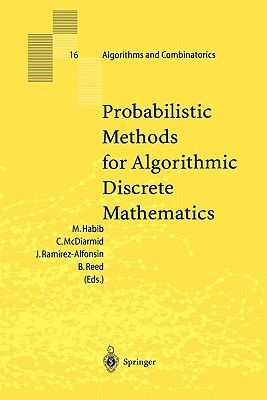
Leave nothing to chance. This cliche embodies the common belief that ran- domness has no place in carefully planned methodologies, every step should be spelled out, each i dotted and each t crossed. In discrete mathematics at least, nothing could be further from the truth. Introducing random choices into algorithms can improve their performance. The application of proba- bilistic tools has led to the resolution of combinatorial problems which had resisted attack for decades. The chapters in this volume explore and celebrate ...
Read More
Leave nothing to chance. This cliche embodies the common belief that ran- domness has no place in carefully planned methodologies, every step should be spelled out, each i dotted and each t crossed. In discrete mathematics at least, nothing could be further from the truth. Introducing random choices into algorithms can improve their performance. The application of proba- bilistic tools has led to the resolution of combinatorial problems which had resisted attack for decades. The chapters in this volume explore and celebrate this fact. Our intention was to bring together, for the first time, accessible discus- sions of the disparate ways in which probabilistic ideas are enriching discrete mathematics. These discussions are aimed at mathematicians with a good combinatorial background but require only a passing acquaintance with the basic definitions in probability (e.g. expected value, conditional probability). A reader who already has a firm grasp on the area will be interested in the original research, novel syntheses, and discussions of ongoing developments scattered throughout the book. Some of the most convincing demonstrations of the power of these tech- niques are randomized algorithms for estimating quantities which are hard to compute exactly. One example is the randomized algorithm of Dyer, Frieze and Kannan for estimating the volume of a polyhedron. To illustrate these techniques, we consider a simple related problem. Suppose S is some region of the unit square defined by a system of polynomial inequalities: Pi (x. y) o.
Read Less
Add this copy of Probabilistic Methods for Algorithmic Discrete to cart. $83.60, good condition, Sold by Anybook rated 5.0 out of 5 stars, ships from Lincoln, UNITED KINGDOM, published 1998 by Springer.
Choose your shipping method in Checkout. Costs may vary based on destination.
Seller's Description:
Volume 16. This is an ex-library book and may have the usual library/used-book markings inside. This book has hardback covers. In good all round condition. Please note the Image in this listing is a stock photo and may not match the covers of the actual item, 700grams, ISBN: 9783540646228.
Add this copy of Probabilistic Methods for Algorithmic Discrete to cart. $84.71, good condition, Sold by Phatpocket Limited rated 5.0 out of 5 stars, ships from Waltham Abbey, ESSEX, UNITED KINGDOM, published 1998 by Springer.
Choose your shipping method in Checkout. Costs may vary based on destination.
Seller's Description:
Good. Ships from UK in 48 hours or less (usually same day). Your purchase helps support Sri Lankan Children's Charity 'The Rainbow Centre'. Ex-library, so some stamps and wear, but in good overall condition. 100% money back guarantee. We are a world class secondhand bookstore based in Hertfordshire, United Kingdom and specialize in high quality textbooks across an enormous variety of subjects. We aim to provide a vast range of textbooks, rare and collectible books at a great price. Our donations to The Rainbow Centre have helped provide an education and a safe haven to hundreds of children who live in appalling conditions. We provide a 100% money back guarantee and are dedicated to providing our customers with the highest standards of service in the bookselling industry.
Add this copy of Probabilistic Methods for Algorithmic Discrete to cart. $116.74, good condition, Sold by Bonita rated 4.0 out of 5 stars, ships from Santa Clarita, CA, UNITED STATES, published 1998 by Springer.