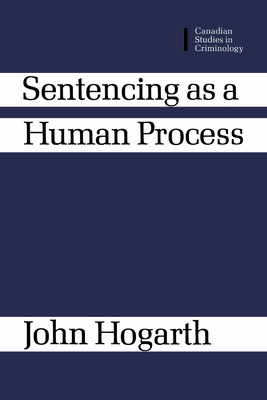
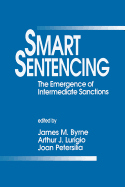
Sentencing is not a neutral or mechanical act; it is a human process, highly charged affectively and motivationally. Sentencing decisions take place in a social environment of laws, facts, ideas, and people. This study of sentencing behaviour is primarily concerned with the mental processes involved in decision-making. It is based on intensive interviews and on measures of the information-processing ability of seventy-one full-time judges in Ontario. The work covers such topics as: problems of sentencing (particularly ...
Read More
Sentencing is not a neutral or mechanical act; it is a human process, highly charged affectively and motivationally. Sentencing decisions take place in a social environment of laws, facts, ideas, and people. This study of sentencing behaviour is primarily concerned with the mental processes involved in decision-making. It is based on intensive interviews and on measures of the information-processing ability of seventy-one full-time judges in Ontario. The work covers such topics as: problems of sentencing (particularly existing disparities); social and economic background of judges and their varying penal philosophies; the nature and measurement of judicial attitudes toward crime; punishment and related issues; prediction of sentencing behaviour based on attitude scales (which the author has constructed) and also on 'fact patterns perceived by judges'; and the impact of social and legal constraints on the sentencing process. The study concludes that there exists a very high correlation between a judges definition of situation and the sentence which he imposes and that while sentences meted out for a particular law violation under similar circumstances may differ among judges, judges are 'highly consistent within themselves.' Using these conclusions the author constructs a model of judicial behaviour and shows how this model can be used to predict and to explain sentencing and breaks new ground in the use of the social and behavioural sciences as sources of data to explain the sentencing process.
Read Less
Add this copy of Sentencing as a Human Process to cart. $47.89, like new condition, Sold by GreatBookPrices rated 4.0 out of 5 stars, ships from Columbia, MD, UNITED STATES, published 1971 by University of Toronto Press.
Choose your shipping method in Checkout. Costs may vary based on destination.
Seller's Description:
Fine. Trade paperback (US). Glued binding. 448 p. Contains: Unspecified. Heritage. In Stock. 100% Money Back Guarantee. Brand New, Perfect Condition, allow 4-14 business days for standard shipping. To Alaska, Hawaii, U.S. protectorate, P.O. box, and APO/FPO addresses allow 4-28 business days for Standard shipping. No expedited shipping. All orders placed with expedited shipping will be cancelled. Over 3, 000, 000 happy customers.
Add this copy of Sentencing as a Human Process (Heritage) to cart. $47.90, good condition, Sold by Big River Books rated 5.0 out of 5 stars, ships from Powder Springs, GA, UNITED STATES, published 1971 by University of Toronto Press.
Choose your shipping method in Checkout. Costs may vary based on destination.
Seller's Description:
This book is in good condition. The cover has minor creases or bends. The binding is tight and pages are intact. Some pages may have writing or highlighting.
Add this copy of Sentencing as a Human Process to cart. $54.34, new condition, Sold by GreatBookPrices rated 4.0 out of 5 stars, ships from Columbia, MD, UNITED STATES, published 1971 by University of Toronto Press.
Choose your shipping method in Checkout. Costs may vary based on destination.
Seller's Description:
New. Trade paperback (US). Glued binding. 448 p. Contains: Unspecified. Heritage. In Stock. 100% Money Back Guarantee. Brand New, Perfect Condition, allow 4-14 business days for standard shipping. To Alaska, Hawaii, U.S. protectorate, P.O. box, and APO/FPO addresses allow 4-28 business days for Standard shipping. No expedited shipping. All orders placed with expedited shipping will be cancelled. Over 3, 000, 000 happy customers.