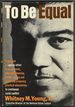
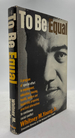
Add this copy of To Be Equal to cart. $30.00, very good condition, Sold by Between the Covers-Rare Books rated 5.0 out of 5 stars, ships from Gloucester City, NJ, UNITED STATES, published 1964 by McGraw-Hill Book Company.
Choose your shipping method in Checkout. Costs may vary based on destination.
Seller's Description:
Near Fine in Very Good jacket. Third printing. 254pp. Slight spotting on the top page edge else near fine in a very good dust jacket with creasing, foxing, and some rubbing. "A program of special effort in employment, education, housing, health, welfare and leadership proposing practical alternative to continuous racial conflict."
Add this copy of To Be Equal to cart. $43.73, fair condition, Sold by ThriftBooks-Dallas rated 4.0 out of 5 stars, ships from Dallas, TX, UNITED STATES, published by McGraw-Hill Book Company.
Add this copy of To Be Equal to cart. $175.00, good condition, Sold by Books From California rated 4.0 out of 5 stars, ships from Simi Valley, CA, UNITED STATES, published 1964 by McGraw-Hill.
Choose your shipping method in Checkout. Costs may vary based on destination.
Seller's Description:
Good in good dust jacket. Signed. First Edition. Signed and inscribed by the author inside the front free end page. 3rd printing. Wear and tear to the jacket. Pages are tanning. Very Clean Copy-Over 500, 000 Internet Orders Filled.
Add this copy of To Be Equal to cart. $250.00, good condition, Sold by Ground Zero Books, Ltd. rated 5.0 out of 5 stars, ships from Silver Spring, MD, UNITED STATES, published 1964 by McGraw-Hill Book Company.
Edition:
First Edition [stated], presumed first printing
Publisher:
McGraw-Hill Book Company
Published:
1964
Language:
English
Alibris ID:
16308566604
Shipping Options:
Standard Shipping: $4.99
Trackable Expedited: $9.99
Choose your shipping method in Checkout. Costs may vary based on destination.
Seller's Description:
Good in Good jacket. 254, [2] pages. Occasional footnotes. DJ has some wear, tears, chips and soiling. Some endpaper and minor page soiling noted. Whitney Moore Young Jr. (July 31, 1921-March 11, 1971) was an American civil rights leader. He spent most of his career working to end employment discrimination in the United States and turning the National Urban League from a relatively passive civil rights organization into one that aggressively worked for equitable access to socioeconomic opportunity for the historically disenfranchised. During World War II, Young was trained in electrical engineering at the Massachusetts Institute of Technology. He was then assigned to a road construction crew of black soldiers supervised by Southern white officers. After just three weeks, he was promoted from private to first sergeant, creating hostility on both sides. Despite the tension, Young was able to mediate effectively between his white officers and black soldiers angry at their poor treatment. This situation propelled Young into a career in race relations. In 1961, at age 40, Young became Executive Director of the National Urban League. He was unanimously selected by the National Urban League's Board of Directors, succeeding Lester Granger on October 1, 1961. [17] Within four years he expanded the organization from 38 employees to 1, 600 employees; and from an annual budget of $325, 000 to one of $6, 100, 000. Young served as President of the Urban League until his death in 1971. In his eulogy, Nixon stated that Young's legacy was that "he knew how to accomplish what other people were merely for". This work offered the author's recommendation for a program of special effort in employment, education, housing, health, welfare, and leadership proposing practical alternatives to continuous racial conflict. At the height of the 1960s Civil Rights Movement, Whitney Young took the fight for equal opportunity from the pulpits and street corners to the board rooms and corner offices of corporate America. Forging allies from Wall Street to the Oval Office, Whitney Young's battle for economic justice and inclusion laid the foundation for an upwardly mobile Black middle class that is still rising today. Though recognized as a major civil rights leader and one of the organizers of the 1963 March on Washington, Whitney Young's strategy of engaging political and corporate leaders as partners in the struggle for economic justice was met with opposition by many Whites and skepticism by more militant Blacks. Despite these challenges, Whitney Young turned the rhetoric of the Civil Rights Movement into jobs and economic opportunity for African Americans. In addition to sitting down with corporate titans, he was a trusted advisor to three presidents-John F. Kennedy, Lyndon B. Johnson and Richard M. Nixon. Johnson used Young's "Domestic Marshall Plan" as the basis for his "War on Poverty.".
Add this copy of To Be Equal to cart. $350.00, like new condition, Sold by Cleveland Book Company rated 5.0 out of 5 stars, ships from Rocky River, OH, UNITED STATES, published 1964 by McGraw-Hill.
Choose your shipping method in Checkout. Costs may vary based on destination.
Seller's Description:
Fine in near fine jacket. Octavo, 254pp. A crisp, clean copy, about fine, in a near fine dust jacket with some rubbing to the base of the spine. This copy SIGNED and warmly INSCRIBED by Young on the front free endpaper: "To Zelma: With respect, admiration and appreciation for you as a real friend and a real "Pro" in the cause. Whitney Young, Jr." Zelma is almost certainly Zelma Watson George, the African-American philanthropist, advisor to President Eisenhower, and opera singer who broke barriers in numerous fields. She was the first African-American to play the lead in Gian-Carlo Menotti's opera "The Medium, " a lead role which would ordinarily have gone to a white woman. She settled in Cleveland, and served on the boards of numerous civic and activist groups. This would account for Young's unusually effusive inscription.